I’ve recently been reading The Hundred Years’ War on Palestine by Rashid Khalidi, which astonished me with the complexity of Middle Eastern history. In this blog I want to summarize some key events that occurred from the turn of the century all the way into the modern era, culminating in the Israel Hamas War happening at the current moment.
A word on the author: Rashid Khalidi is a member of a historically prominent family in Palestine. His family has been embroiled in Palestinian politics even before it was founded. His great-great-great uncle, Yusuf Diya al-Din Pasha al-Khalidi, was the mayor of Jerusalem during the late 19th century, and became an prophetic leader who spoke about the dangers of Zionism during Theodore Herzl’s campaign. His major link to proto-Zionism came from a letter he addressed to Herzl personally in 1896. There, he emphasized the colonial nature of the Zionist enterprise, requiring the displacement of millions of indigenous people. He concluded with a heartfelt plea: “in the name of God, let Palestine be left alone”.
The book follows the thread left off by Yusuf Diya. It recounts how his prescient concerns over Zionism actualized itself in the form of a specialized colonialism involving the European Jews and aided by the British over hundreds of years of practice in brutal colonialist campaigns.
1896. Theodore Herzl publishes the pamphlet Der Judenstaat, a Zionist article calling for a national Jewish home in the area that is now Palestine. There are no explicit references to indigenous Arabs living in the region, and his speech implied a demeaning plan of gentrification.
We must expropriate gently the private property on the estates assigned to us. We shall try to spirit the penniless population across the border by procuring employment for it in the transit countries while denying it employment in our own country. The property owners will come over to our side. Both the process of expropriation and the removal of the poor must be carried out discretely and circumspectly.
1896. al-Khalidi responds to Herzl’s message, warning him about the potential dangers and harm that his enterprise will achieve.
1905. Arthur Balfour passes the Aliens Act, which kept Jewish refugees originating from Russian pogroms away from Britain. This implies that Zionism was in some part inspired by British anti-semitism.
1908. The Young Turk Revolution is successful, constitutionalizing the Ottoman Empire under Abdul Hamid II. The committee of Union and Progress now rule the Ottoman Empire.
1909-1914. 42,000 Jewish immigrants arrived at Palestine, and began to take over peasant land from the fertile Marj Ibn Amer and Huleh valleys. Surreptitious development of paramilitary forces commenced.

Marj Ibn Amer (Jezreel Valley) 
Huleh Valley 1911. Issa al Issa publishes the newspaper Filastin (Arabic for Palestine). It was the country’s fiercest and most consistent critic of Zionism, denouncing it as a threat to Palestine’s Arab population. The newspaper, which addressed its readers as Palestinians since its inception, helped shape Palestinian identity and was shut down several times by British and Ottoman officials.
1914. At Whitehall, Herbert Samuel, Zionist and leader of the Liberal Party, offered Chaim Weizmann (successor of Herzl) a Jewish homeland complete with funded developments. He gradually established connections with David Lloyd George (Prime Minister) and Arthur Balfour (foreign secretary) and converted them into his Zionist cause.
1915-1918. Greater Syria (including modern day Palestine, Jordan, Lebanon) suffers more than one million deaths due to famine and World War I. A total of 3 million people died in the Ottoman Empire.
1915. Hussein bin Ali, Sharif of Mecca began the Great Arab Revolt with British support. He liberated Mecca and Ta’if in July and September of 1916 respectively, and set up his own Kingdom of Hejaz. In return of his support of the Allies during the war, the British agreed to recognize Arab independence in a large region, promised by the McMahon–Hussein Correspondence. The area promised to Hussein excluded only the territory to the west of a line from Damascus north to Aleppo. Palestine, far to the south, was, by implication, included.
His sons eventually became Emir Faysal of Iraq and Abdullah I of Transjordan.
1916. The British and the French devise the Sykes Picot agreement to partition Ottoman territory after the war is finished. The agreement allocated to the UK control of what is today southern Israel and Palestine, Jordan and southern Iraq, and an additional small area that included the ports of Haifa and Acre to allow access to the Mediterranean. France was to control southeastern Turkey, the Kurdistan Region, Syria and Lebanon.
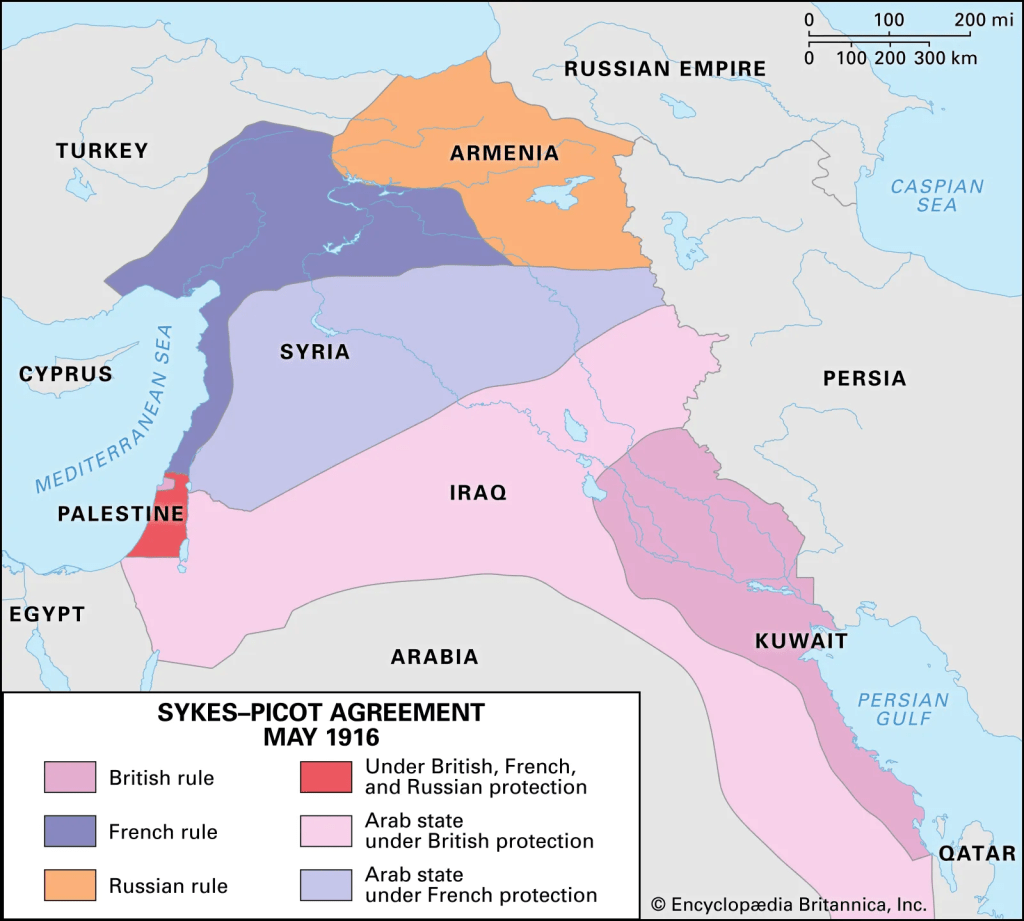
The Sykes-Picot line Many Arabs at the time, including Hussein, Sharif of Mecca, considers this a direct violation of the Hussein-McMahon correspondence.
1917. The British took over Palestine, lasting all the way until 1939.
1917. The Balfour Declaration was published by Arthur James Balfour, although it did not reach the Palestinians for two years due to heavy censorship. The declaration did not mention the political rights or identity of the native inhabitants (which accounted for about 94% of the total population), promising only “civil and religious rights”.
His Majesty’s Government view with favour the establishment in Palestine of a national home for the Jewish people, and will use their best endeavours to facilitate the achievement of this object, it being clearly understood that nothing shall be done which may prejudice the civil and religious rights of existing non-Jewish communities in Palestine, or the rights and political status enjoyed by Jews in any other country.
1919. Arif al-Arif and Muhammad Hasan al-Budayri publishes Suriyya al-Janubiya (Southern Syria) entertaining the idea of Palestine being incorporated as part of Greater Syria.
1920. Faysal gets kicked out of French Mandated Syria, but is granted King of Iraq by the British.
1921. Abdullah I became Emir of Transjordan for his contributions in the Great Arab Revolt.
1921. Amin al-Husayni was chosen by the British to become the Grand Mufti of Palestine. Another position, the head of the Arab Executive was given to his cousin, Musa Kazim Pasha al-Husayni. The establishment of these positions was a maneuver by the British to instigate friction between the two men.
1922. The British Mandate for Palestine is established by the League of Nations.
Rashid Khalidi has this to say to the preamble of the Mandate:
In the eyes of the drafters, the entire two-thousand-year-old built environment of the country with its villages, shrines, castles, mosques, churches, and monuments dating to the Ottoman, Mameluke, Ayyubid, Crusader, Abbasid, Umayyad, Byzantine, and earlier periods belonged to no people at all, or only to amorphous religious groups.
There are no references to Arabs, Palestinians in the next 28 articles.
Article 2 proclaimed the yishuv (Jewish population) to be a self-governing institution.
Article 4 proclaimed the Jewish Agency (the Jewish government) quasi-government status as a “public body” with economic and social influence over the governed, as well as international diplomatic status.
Article 6 Facilitated increased Jewish settlement.
Other articles allowed Jewish Agency to take over public works, including making Hebrew the official language.
1919-1928. There were 7 Palestine Arab Congresses. However, the Arab executives that met repeatedly with the British amounted to little.
Around the same time, the Palestine Istiqlal Party (IndependenceParty) was formed.
Haifa based militant Shaykh Izz al-Din al-Qassam began targeting British and Jewish settlements. He was later executed.
These events led to the Arab Revolts of 1936-39.
1933. The Haavara Agreement (Transfer Agreement) was made between German Jews and the Nazi Party. German Jews were allowed to bring assets up to $100 million to Palestine to lift the Jewish boycott of Germany.
1936. 6 month strike by the Arabs. The Arab Higer Committee (AHC) was created to quell the strike.
July 1937. The Peel Commission was created. The commission would lead to the Jews occupying a territory of about 17% of Palestine, and 200K Arabs would be expelled from their homeland. Additionally, the rest of the country was to be under the control of the Transjordan king Abdullah I, which was heavily influenced by the British.
October 1937. Armed revolts ensued after the rejection of the Peel Commission. The British response was drastic exacerbated after the assassination of the British commissioner Lewis Andrews by Palestinians.
1939. The revolts continued all the way until 1939, where it took 100K British troops to finally quell the rebellion. 14-17% of the total adult male Arab population were killed/wounded/imprisoned. Brutal atrocities were committed by the British including summary executions, and the demolition of homes and families of rebels. During this time, the entire Palestinian nationalist leadership was deported to Seychelles Islands.
1939. Neville Chamberlain suggested the White Paper in response to the Arab revolts. It included the curtailment of Jewish immigration, and promised representative institutions for Arabs, along with self-determination, both contingent on the approval of all parties. The Arabs later rejected this Paper, because
- They have no way of ascertaining Britain’s promise, and many felt that they were being “drugged” into complacency
- Both representation and self-determination were contingent upon the approval of the Zionists, which clearly would not have happened.
 Kepha
Kepha 
Leave a comment