1942. The Biltmore Program convenes in New York. It is a major Zionist conference that called for the turning of all Palestine into a Jewish Commonwealth. The program has been described by a number of historians as “a virtual coup d’état” within Zionism since the movement’s more moderate leaders were replaced with leaders with more aggressive goals.
1944-1946. A military formation of the British Army formed during late 1944. It comprises mostly of Yishuv Jews from Mandatory Palestine. In contrast, there were no corresponding military formation for the Arabs. The military training the Jews received during this time is pivotal to the formation of the Israel army after their independece.
3/1945. The Arab League was formed in Cairo, consisting of Egypt, Iraq, Transjordan, Lebanon, Saudi Arabia, Syria, and Northern Yemen. Palestine references were removed during inauguration and blocked by the Egyptian prime minister. Musa Alami, the Palestinian emissary, was finally allowed to attend after consent from a British intelligence officier.
1946. Formation of the Anglo-American Committee of Inquiry, a joint British and American committee assembled in Washington, D.C. It was established to deal with the Jewish refugee status, effectively negating the 1939 Chamberlain White Paper.
The Palestinian case presented a problem. First, major members of the Arab Higher Committee were sent to exile during the Arab revolts, leaving the organization handicapped. Additionally, there were no bureaucratic apparatus, not even secretaries.
1946. In response to the dissolved state of the AHC, the Arab Office was formed by Musa Alami. Set up as the nucleus of a Palestinian foreign minitry and supported mainly by the pro-British Iraqi government headed by Nuri al-Sa’id, the Arab Office had both a diplomatic and informational mission, with the goal of making the Palesinian cause better known. It included people such as Ahmed Shukeiri (first chairman of the PLO), Albert Hourani (prominent historian on the Middle East), who also delivered the Palestinian case to the Committee of Inquiry.
Inter-Palestinian Differences
Much division was present within Palestine during this time. The pre-war polarization of the Mufti, Amin al-Husayni continued to the post-war era. Division was intensified by Britain’s unremitting opposition to both the Mufti and any independent Palestinian organization. In the Arab Office, there was a divide between Musa Alami and Husayn al-Khalidi due to Alami’s closeness to the pro-British Iraqi regime.
Yusif Sayigh critiques the Mufti’s out-dated modes of thinking regarding governing Palestine:
The basic weakness of the mufti was that he thought that the merit of the cause he was working for, namely setting up an independent Palestine, saving Palestine from takeover by the Zionists, was enough in itself. Because it was a just cause, he did not build a fighting force in the modern sense…. I think part of it was that he feared a big organization, he felt that he could not control a big organization. He could not control a big organization. He could control an entourage, people to whom he whispered and who’d whisper to him. A big organization would have to be decentralized to a certain point, and he would lose touch. And perhaps he would have to depend on him, and they would depend less on him. Perhaps he was afriad that some leading young fighter would emerge who would be charismatic and would take away some of the loyalty and support that was his.
Khalidi comments: except for Egypt, where the Wafd, a geniune mass-based political party, had dominated the country’s politics since 1919, nowhere had these formations developed to the point that they eclipsed the “politics of the notables”, as Albert Hourani masterfully described it in a famous 1968 essay.
Financed primarily by Iraq’s Nuri al-Sa’id and his British backed government, the Arab Office eventually alienated other Arab states, notably Egypt and Saudi Arabia, which both aspired to pan-Arab leadership. They think that the creation of the Arab Office was a vehicle for Iraq’s regional ambitions.
1946. The British administrative headquarters for Mandatory Palestine, housed in the southern wing of the King David Hotel in Jerusalem, was bombed in a terrorist attack by the right wing Israeli group Irgun. 91 people were killed, and subsequently Great Britain finally capitulated in Palestine. This signifies the break between Britain and Israel.
7/1947. The author’s father Ismail Khalidi informs King Abdullah of Transjordan that the AHC rejects Transjordan protection of Palestine, desiring Palestinian autonomy from the pro-British Transjordan.

11/29/1947. UN Resolution 181 passed. 56% of Palestine were to be given to Israel. Britain essentially thrown the problem to the UN.
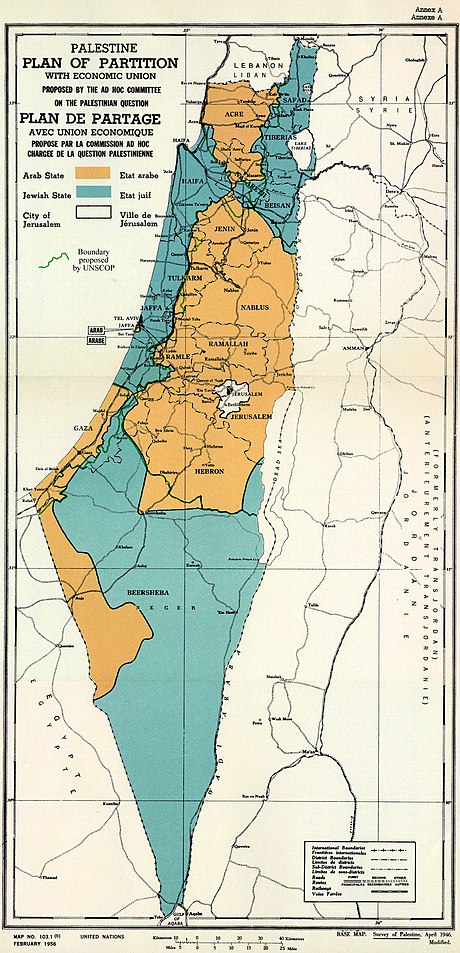
11/30/1947 – 5/15/1948. One day after the resolution, the first phase of the Nakba begun. Israeli paramilitary groups — Irgun, Haganah, and Lehi — began a countrywide offensive, Plan Dalet, forcibly removing about 300K Arabs from their homes (about 25% of the total population).
- Tiberias, 4/18, 5K removed
- Haifa, 4/23, 60K removed
- Jaffa, 4/29, 60K removed
- Safad, 5/10, 12K removed
- Beison, 5/11, 6K removed
- West Jerusalem, 30K removed.
5/15/1948 – 10/1948. Israel declared independence on 5/15/1948, the last British troops pulled out during the same time.
- Arab League army joined
- Another 400K were expelled
- King Abdullah of Transjordan benefitted from the war: he initially colluded with the British to keep the West Bank and East Jerusalem after the Mandate. But after the Israeli invasion, he used his own forces — the Arab Legion — to keep Israel out of East Jerusalem and the West Bank so he could keep it for himself. He also followed the orders of the British Allies of not invading Israel.
- The Lebanese army never crossed their borders.
- Iraq’s army also refrained from invading Israel due to Britain’s orders.
- Egypt now controls the Gaza.
- King Abdullah granted citizenship to all Palestinian refugees. Lebanon, however, were not so generous due to the delicate religious balance set forth by the French Mandate (with Maronites ruling the country)
Khalidi comments:
It ranked the abrupt collective disruption, a trauma that every Palestinian shares in one way or another, personally or through their parents or grandparents.
10/1948. The Palestinian Communist Party merged with the Israeli Communist Party, and renamed themselves to be Maki. This is one of the first (though not the first) joint Arab-Jew parties in Israel, since Arab only parties were banned at that time. The party was not Zionist, but recognized Israel, though it denied the link between the state and the Jewish diaspora, and asserted the right of Palestinians to form a state in accordance with the United Nations resolution on partition.

1949. The United Nations Relief and Works Agency for Palestine Refugees in the Near East (UNRWA) was created. Originally intended to provide employment and direct relief, its mandate has broadened to include providing education, health care, and vocational training to its target population in Syria, Jordan, Lebanon. Due to UNRWA camps, Palestinian literacy rates are among the highest of all Arab nations.
1951. King Abdullah was assassinated by members affiliated with the Mufti.
1952. Egypt coup de état placed Gamal Abdel Nasser as president.
1952-1956. Palestinian activities (PLO, etc) were suppressed in Egypt and Jordan. Even to the degree of impersonating and killing them. Egypt, with its new president, was afraid to engage with the agressive Ben-Gurion.
10/1956. Suez War occurred after Egypt closed off the Suez canal. Israel, France, and Britain were allied by the protocol of Sevres. Britain still wanted to maintain colonial control over Egypt, which looked really bad on the international stage. The USSR was more than happy to publicly denounce this war as a colonial war to distract the world from its brutal crackdown of the Hungarian protests. Hence, both the USSR and the USA condemned the war.
11/1956. Israel, Britain, and France pulled out. Israel committed massacres in the city of Khan Yunis (11/3) and Rafah (11/12), summarily executing a total of 450 Palestinians, even after the war is over.
- Comment
- Reblog
-
Subscribe
Subscribed
Already have a WordPress.com account? Log in now.
 Kepha
Kepha 
Leave a comment